Most organisations have been through the AI strategy workshop. They have the framework, the principles, the roadmap pinned to a wall somewhere. What most of them do not yet have is working AI in production.
The gap between strategy and implementation is where most AI initiatives stall. Not because the technology does not work, but because organisations try to jump from “we should use AI” to “we have AI agents running our business” without building the literacy, governance and operational muscle in between.
This post introduces our enterprise AI adoption framework, a three-tier model we use with clients to sequence AI adoption safely. It is not a maturity model you file away. It is a decision tool you use before every deployment.
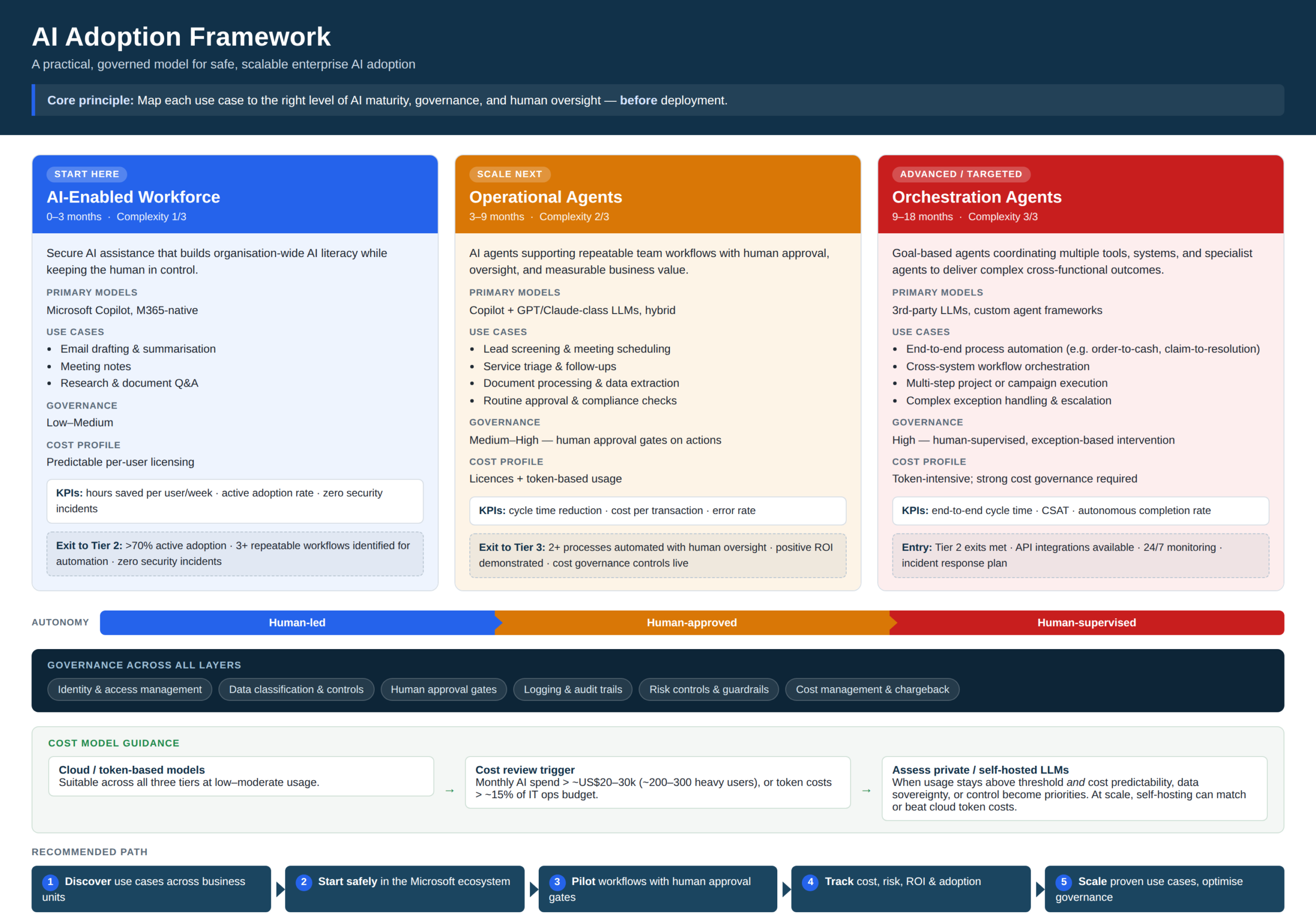
Tier 1: AI-Enabled Workforce (0 to 3 months)
The foundation layer. Secure AI assistance that builds organisation-wide AI literacy while keeping the human in control.
Primary models: Microsoft Copilot, M365-native
Use cases: Email drafting and summarisation, meeting notes, research and document Q&A
Governance: Low to Medium
Cost: Predictable per-user licensing
The goal here is not automation. Rather, it is literacy. You are building the organisational muscle to use AI tools safely, understand their limitations, and identify which workflows are actually worth automating.
KPIs: Hours saved per user per week, active adoption rate, zero security incidents
Exit criteria: More than 70% active adoption, three or more repeatable workflows identified for automation, zero security incidents
Tier 2: Operational Agents (3 to 9 months)
AI agents supporting repeatable team workflows with human approval, oversight, and measurable business value.
Primary models: Copilot plus GPT/Claude-class LLMs, hybrid
Use cases: Lead screening and meeting scheduling, service triage and follow-ups, document processing and data extraction, routine approval and compliance checks
Governance: Medium to High (human approval gates on actions)
Cost: Licences plus token-based usage
This is where AI starts doing real work, but with training wheels. Every agent action goes through a human approval gate. You are measuring cycle time reduction, cost per transaction and error rates. If the numbers do not stack up, you do not scale.
KPIs: Cycle time reduction, cost per transaction, error rate
Exit criteria: Two or more processes automated with human oversight, positive ROI demonstrated, cost governance controls live
Tier 3: Orchestration Agents (9 to 18 months)
Goal-based agents coordinating multiple tools, systems and specialist agents to deliver complex cross-functional outcomes.
Primary models: Third-party LLMs, custom agent frameworks
Use cases: End-to-end process automation (for example order-to-cash, claim-to-resolution), cross-system workflow orchestration, multi-step project or campaign execution, complex exception handling and escalation
Governance: High (human-supervised, exception-based intervention)
Cost: Token-intensive, strong cost governance required
This is the target state, not the starting point. Orchestration agents work across systems, make decisions within defined boundaries, and escalate to humans only when they hit exceptions.
KPIs: End-to-end cycle time, CSAT, autonomous completion rate
Entry criteria: Tier 2 exits met, API integrations available, 24/7 monitoring capability, incident response plan
The Governance Thread
Notice the progression: Human-led to Human-approved to Human-supervised. Autonomy increases as trust is earned, not as capability is unlocked.
The enterprise AI adoption framework applies the same governance controls across all three tiers: identity and access management, data classification and controls, human approval gates, logging and audit trails, risk controls and guardrails, cost management and chargeback.

The Cost Reality Check
Cloud and token-based models suit all three tiers at low to moderate usage. A review becomes due when monthly AI spend exceeds roughly twenty to thirty thousand dollars (about two hundred to three hundred heavy users), or when token costs exceed fifteen percent of your IT operations budget. At that point, it is worth assessing private or self-hosted LLMs. At scale, self-hosting can match or beat cloud token costs, depending on your workload and operating model.
How to Apply the Enterprise AI Adoption Framework
Before your next AI deployment, ask three questions:
- Which tier does this use case actually belong to?
- Have we met the exit criteria from the previous tier?
- Do we have the governance controls for this tier already in place?
If the answer to question two or three is no, you are not ready to move up. That is not a failure. In fact, it is the framework working as intended.

How Evocate Helps
We work with organisations at every tier of this framework.
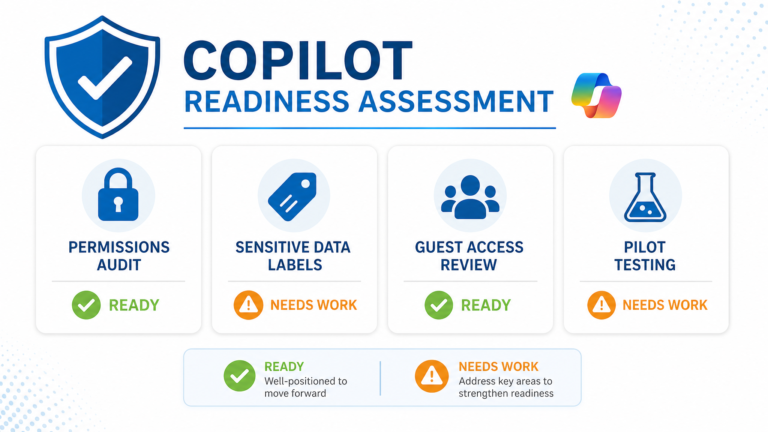
For Tier 1, our Microsoft 365 Copilot readiness and adoption services help you deploy Copilot safely, drive adoption and measure real value. We start with a Copilot Readiness Assessment to identify data exposure risks, then move to structured adoption programs that build AI literacy without creating governance gaps.
For Tier 2, our AI Agents and Automation team designs and implements agents that handle real business processes with human oversight. We connect Copilot Studio, Power Automate and your existing systems to automate workflows like document processing, service triage and onboarding coordination.
For Tier 3, our AI Strategy and Roadmap service helps you plan the architecture, governance and integration patterns needed for orchestration agents. We assess whether private AI infrastructure makes sense for your scale, and we design the human supervision model that keeps you in control.
If you are not sure which tier you are on, start with an AI Readiness Assessment. We will tell you honestly where you stand and what needs to change before you invest further.
Frequently Asked Questions
You can, but you probably should not. Tier 1 builds the organisational literacy and governance muscle that Tier 2 depends on. Skipping it means your agents will be designed by people who do not yet understand how AI behaves in your environment, which usually leads to poor outcomes.
The timeframes are indicative. Tier 1 typically takes two to four months to reach the exit criteria. From there, Tier 2 takes three to six months per workflow, while Tier 3 usually runs six to twelve months from Tier 2 exit. The critical path is not the technology. Instead, it is the governance, change management and measurement discipline.
You are in Tier 1 but at risk. Copilot without governance is shadow AI at scale. A <a href=”/ai-implementation/copilot-readiness/”>Copilot Readiness Assessment</a> will identify your exposure and help you retrofit controls before you expand usage.
No. The enterprise AI adoption framework is platform-agnostic. Microsoft Copilot and M365 are the natural starting point for Tier 1 because most organisations already have the licences. Tier 2 often adds GPT or Claude-class models. Tier 3 may use custom frameworks. The framework governs the adoption pattern, not the vendor choice.
Treating AI adoption as a technology project instead of an organisational change program. The technology is the easy part. Building the literacy, governance and measurement discipline is what takes time.
Get in Touch
If you are looking at AI adoption and want a practical framework that connects strategy to working production systems, get in touch with Evocate. We will help you assess where you are, plan the sequence, and implement the governance that makes AI work in the real world.